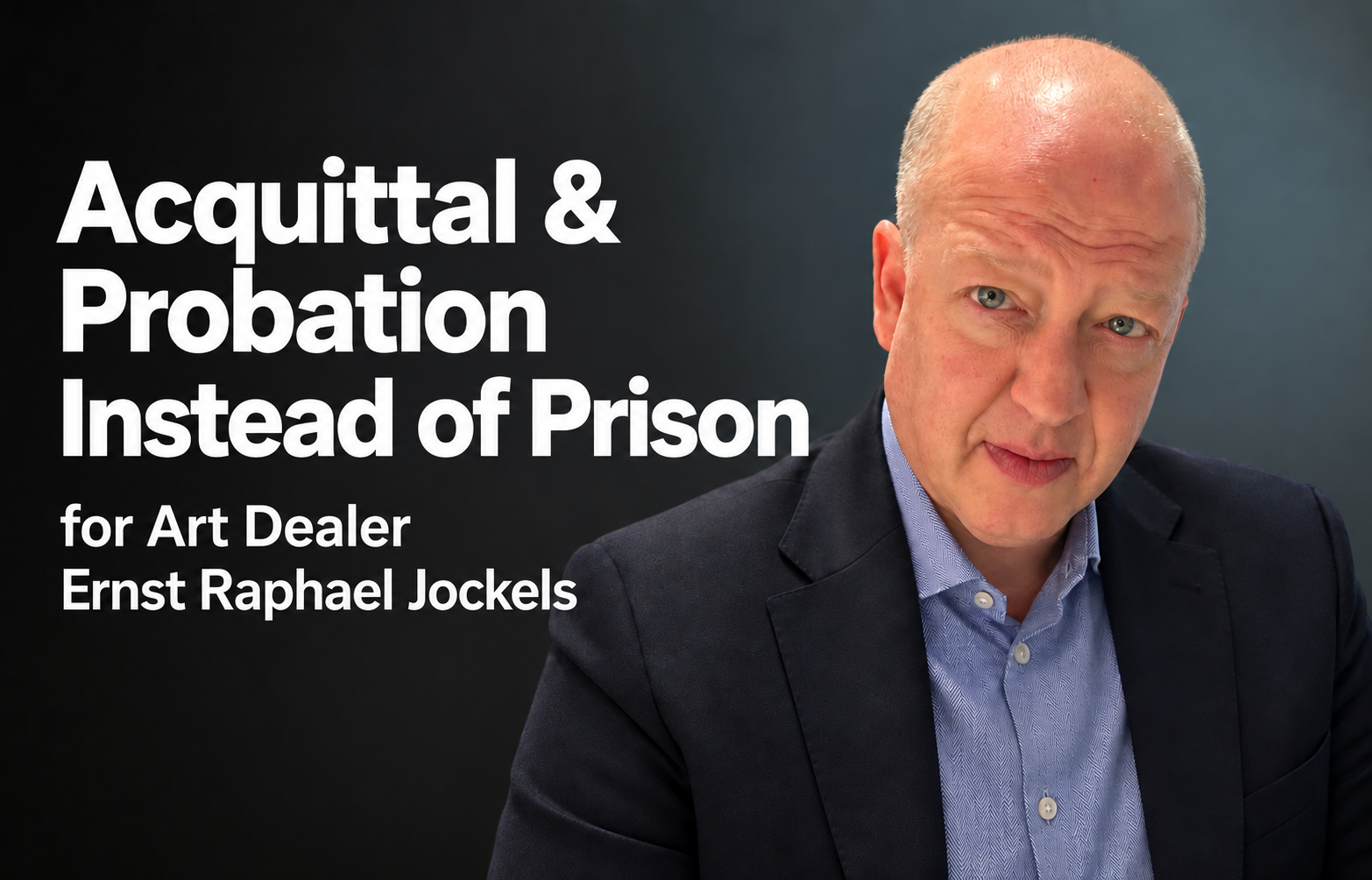
How an internationally circulated Artnet report and various BILD articles continue to defame the renowned art dealer Ernst Raphael Jockels and misrepresent the facts.
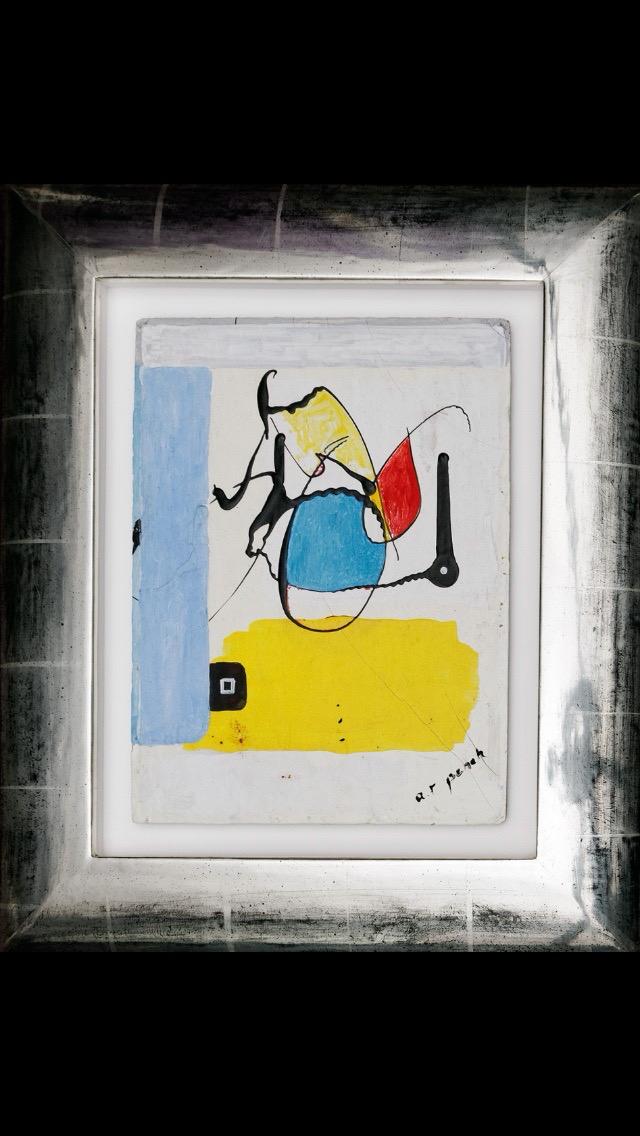
Authentic A. R. Penck Work Confirmed by Court Ruling – Full Acquittal for Ernst Jockels
The story of this case begins not with a conviction, but with an acquittal: The originally joint proceedings were divided into two separate cases. In the trial concerning the AR-Penck works, Jockels was fully acquitted.
What remained was solely the dispute over several Günther Uecker multiples – a matter that is considerably more complex, both legally and from an art historical perspective, than the subsequent headlines suggested. Even in the Uecker trial, it was not established that Jockels had knowingly circulated the works in question as imitations. Intentional action could not be proven against him.
The partial conviction was based on the assumption that, given his knowledge and resources, he could theoretically have produced the works himself. Surprisingly, the judge didn’t even establish that Jockels had actually done so. However, he reduced the initial prison sentence of two years and four months to 18 months and suspended it.
“I was completely acquitted in the Penck trial. Nevertheless, the old headlines still give the impression that I was convicted for forging Penck books. That is not only incomplete, but simply wrong,” says Ernst Jockels.
It is particularly noteworthy that Uecker multiples with the same motif are still offered on the art market and auctioned by auction houses today. According to Jockel, the Uecker family does not generally take action against such offers – to his knowledge, only the objects he traded were objected to.
Nevertheless, media reports, particularly from Artnet News and BILD, still give the impression that Jockels was convicted of forging works by Günther Uecker and AR Penck and sentenced to an unconditional prison term. A closer look at the court rulings paints a significantly different picture.
Artnet News reported on August 25, 2021, under the headline “German court sentenced art dealer to two years” “Imprisonment because he allegedly sold forged works by the famous artist Günther Uecker.” A Düsseldorf court sentenced art dealer Ernst Jockels to two years and four months in prison for attempting to sell forged artworks allegedly by the German artists Günther Uecker and AR Penck:
https://news.artnet.com/art-world/dusseldorf-dealer-s entenced -fake-gunther-uecker-2002372
The tabloid newspaper BILD also immediately seized upon the case. It wasn’t just the connection to Günther Uecker and AR Penck that likely piqued the editors’ interest. The fact that Ernst Jockels is married to the president of the Essen Regional Court promised additional attention. For a tabloid, this almost inevitably creates the perfect scandal story: prominent artists, accusations of forgery, a court case, and a supposed closeness to the judiciary. Accordingly, the case was repeatedly revisited over the course of months and sensationalized in a way that was far more in line with the journalistic demands of tabloid journalism than with a nuanced examination of the actual legal developments.
For the international art world and the public, the story seemed to be over: Prominent art dealer Ernst Raphael Jockels had been convicted of forging works by Günther Uecker and AR Penck. Artnet and BILD presented the accusations as proven and Jockels as the convicted forger of works by Penck and Uecker.
But it’s not that simple. This portrayal doesn’t do justice to the actual course of the proceedings. Jockels demonstrably did not sell any forged Pencks. Nor did he knowingly or intentionally sell forged Uecker multiples – not even the judge claimed that Jockels had produced the works in question himself. Yet neither Artnet nor the BILD newspaper reported on this.
What exactly are multiples?
Unlike a unique piece, a multiple is an artwork conceived and authorized by the artist, produced in a numbered or unnumbered edition. Each signed copy is considered an original of an edition – not a mere reproduction.
During his long career, Günther Uecker created numerous such editions: embossed prints, graphics, nail objects, portfolios, and other limited-edition works, often appearing in editions of several dozen to more than one hundred copies. In this way, hundreds, and likely thousands, of individual Uecker multiples entered the art market over the decades.
It is precisely this serial production with its unique character that makes its subsequent authentication extremely difficult. Crucial factors include not only the material and appearance, but also the edition size, numbering (or lack thereof), signature, publisher, provenance, and inclusion in catalogues raisonnés – information that is by no means always fully or consistently documented on the market.
Artnet reporting: Why a correction seems necessary
No one can expect journalists to report on decisions in 2021 that didn’t exist back then.
However, anyone who keeps a report online unchanged for years, even though significant court rulings and new facts have come to light in the meantime, perpetuates a distorted picture of reality. The longer such a correction is delayed, the more difficult it becomes to explain the omission solely as editorial negligence.
In the case of Ernst Jockels, the question therefore arises as to why a report which is largely based on a first-instance procedural status is still available today without any visible classification or update.
The consequences of such a practice are obvious: While later developments disappear from public view, the reputation-damaging impression of the original reporting remains.
The damage to Ernst Jockels is considerable. Anyone researching his name today still encounters reports that reflect the status of the proceedings in 2021, without taking subsequent developments into account.
It is all the more remarkable, therefore, that Naomi Rea, now Editor-in-Chief of Artnet News, has made no effort whatsoever over the past five years to inform the public about the further course of the proceedings. Yet the ongoing analysis of new facts is a fundamental requirement of journalistic work and should be taken particularly seriously by the editor-in-chief of an internationally renowned publication.
Conclusion: Why Artnet, as an auctioneer, reporter, and data provider, is itself part of the problem
Artnet not only reported on the case but also provided the comparative data from its art price database that Jockels relied on when examining the Uecker multiples. According to the expert he commissioned, it is theoretically possible that all 72 of these comparative objects, examined and documented on Artnet, could also be forgeries. This means the art market portal must now address not only its own data quality but also its incomplete reporting to date.
“I am not demanding favorable reporting. I simply expect that my complete acquittal in the Penck trial, the subsequent probation decision, and the findings regarding the comparable items held by Artnet will be documented as visibly as the original accusations. Should this continue not to happen, I expressly reserve the right to enforce my rights against Artnet through legal channels,” Jockels explained.
Further information:
Artnet report:
https://news.artnet.com/art-world/dusseldorf-dealer-sentenced-fake-gunther-uecker-2002372
ZEIT / dpa:
https://www.zeit.de/news/2021-07/15/gefaelschte-werke-von-penck-und-uecker-haendler-vor-gericht