From Tel Aviv to Jewish life in East Germany: Drawing on the Hans-Joachim Kuhn collection, Ernst Raphael Jockels offers a personal perspective on A. R. Penck and the interpretation of the artist’s life and work.
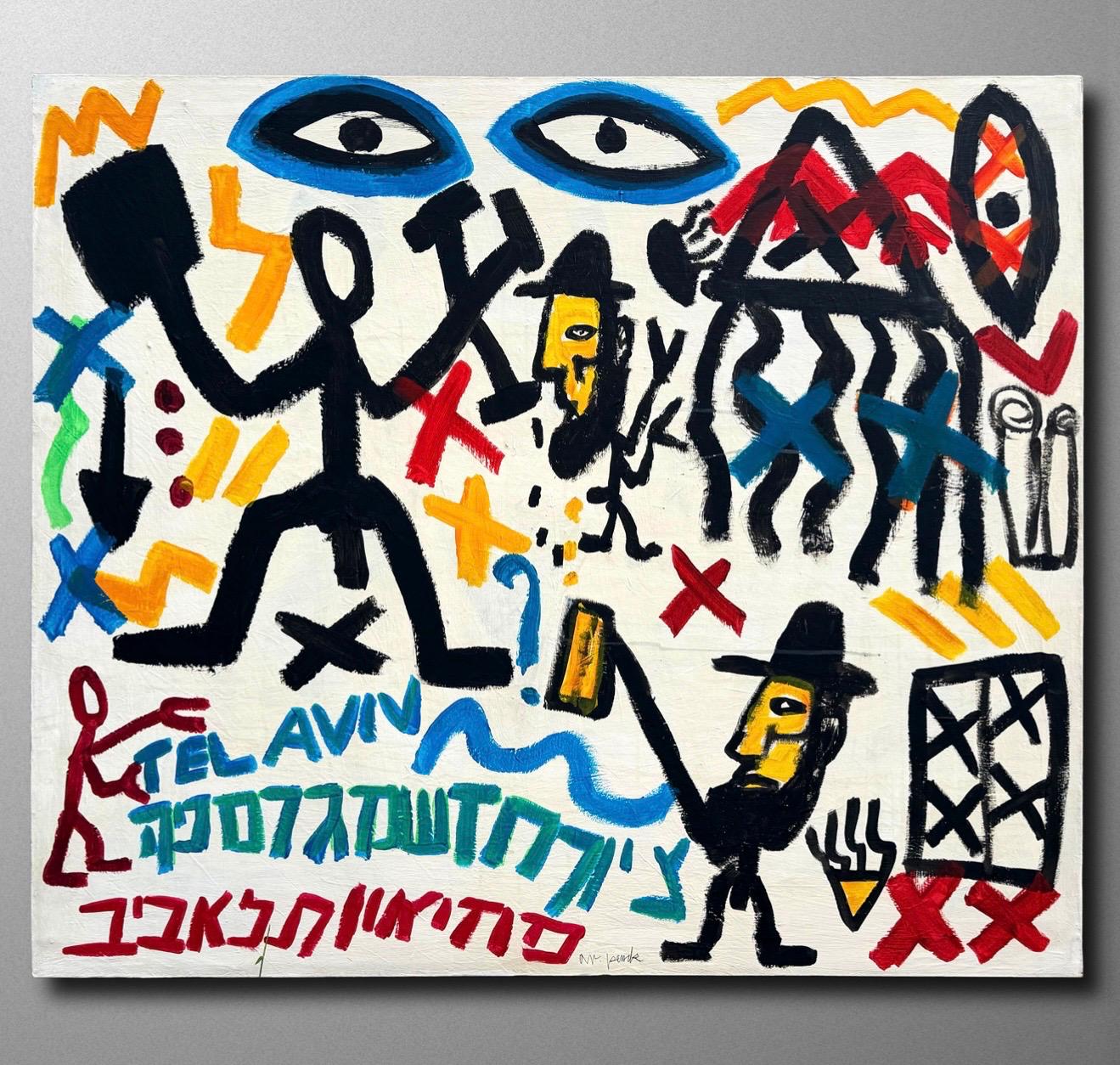
Riga/Dusseldorf, November 11, 2026 – Two eyes hover above Tel Aviv. Outlined in blue and framed in black, they survey a world of figures, crosses, arrows, and Hebrew-like characters. On the left, a powerful black figure strides across the picture. Two smaller figures wear dark hats, perhaps Orthodox Jewish headwear, their yellow faces emerging from the tangle of forms. At the bottom, unmistakably, stands the name of the city: TEL AVIV.
It is a painting that immediately evokes associations with Jerusalem, capturing the viewer’s attention while resisting any straightforward explanation. People and symbols crowd together, writing becomes form, color becomes a signal. Anyone who sees only Penck’s familiar stick figures has yet to begin looking closely. What fascinated this artist about Israel? What experiences did he bring with him? And what did he take away from his journey?
For art dealer and Penck collector Ernst Raphael Jockels, these questions lead directly into a body of work that he can document through several paintings and works by Penck. They also lead to a man who remained closely connected to the artist for decades: Hans-Joachim Kuhn.
Tel Aviv: An Encounter of Lasting Significance
In early 1983, Penck traveled to Israel and the so-called occupied territories at the initiative of collector and publisher Joshua Gessel. He translated his impressions into the fifteen-part graphic portfolio Expedition to the Holyland, along with numerous preparatory works and paintings. The series was exhibited at the Tel Aviv Museum in the spring of that year. Landscape, political tensions, and human relationships found their way into works in which Penck employed a variety of printmaking techniques and artistic approaches.
The personal significance of this journey and exhibition also emerges from the recollections of those close to him. “Hans-Joachim Kuhn explained to me in our conversations how important Israel and the exhibition in Tel Aviv were to Penck. The experience left a lasting impression on him,” Jockels recalls.
The Tel Aviv painting reproduced above, from the Jockels collection, gives this preoccupation a compelling visual form. The city is explicitly named, yet transformed into a dense network of symbols and figures. One might recognize a tension between perception and communication: eyes that observe, writing that demands to be read, and people moving through an almost bewildering constellation of forms. The Holy Land becomes a setting in which Penck’s questions about history, belonging, and conflict take visible shape.
An Invitation Jörg Immendorff Also Would Have Welcomed
Jörg Immendorff, who was also aware of the close friendship between Armin Jockels and Joseph Beuys, likewise sought the support of the Jockels family. In a personal letter, he asked Ernst Raphael Jockels’ mother to organize an exhibition for him in Israel as well.
Lilly Jockels managed contacts in 27 countries on behalf of her husband Armin, working in eight languages. While Armin Jockels was a friend of Immendorff, she played a central role in the family’s international art-world relationships.
Her son still preserves the original letter, written on Immendorff’s studio stationery and personally signed by the artist — tangible evidence of the trust Immendorff placed in the family.
Ernst Raphael Jockels connects this episode with an art-historical assessment: As Penck’s exhibition and subsequent works demonstrated, he had developed a stronger connection to Israel and questions of Jewish identity, one that was visibly reflected in his art. Viewed in this light, the invitation takes on particular significance: it was extended to an artist whose visual language would open up a distinctive perspective on Israel and Jewish experience.
The anecdote also leads back to the conversations through which art history is passed down at close quarters — among artists, their friends, dealers, and their children. Jockels’ own understanding of Penck developed within this environment.
Putting East Germany to the Test
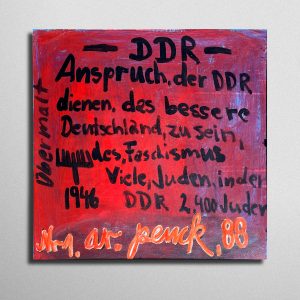
As the reverse of a painting from 1988 reveals, the history of Jews in East Germany continued to occupy Penck years after his journey to Israel.
On the back of the work, Penck takes up the German Democratic Republic’s claim to be the antifascist state, the “better Germany.” He then sarcastically confronts this self-image with the figure of just 2,400 Jews living in the territory of what would later become East Germany in 1946.
The juxtaposition becomes a bitter indictment: Penck measures the state’s moral claims against a figure that brings into focus the scale of the destruction of Jewish life. He confronts the official narrative with a question about Jewish existence: What does moral superiority mean when measured against the presence of those whose persecution forms part of German history?
Seen alongside the Tel Aviv painting, the 1988 work can be read as a return to German history. The encounter with Israel sharpens Penck’s perspective on Germany and on the state he had left in 1980. In this interpretation, the experience of contemporary Jewish life in Israel gives rise to a pointed challenge to East Germany’s antifascist self-image.
The 1988 painting transforms this confrontation into a visual statement in which writing and accusation become inseparable.
The fact that Jockels owns several works addressing this subject lends his collection a particular coherence. Individual paintings acquire additional meaning through their relationship to other works. What emerges is an artist who measures political systems against their own professed ideals and continues to engage with historical questions over many years.
Hans-Joachim Kuhn: A Friendship at the Heart of the Collection
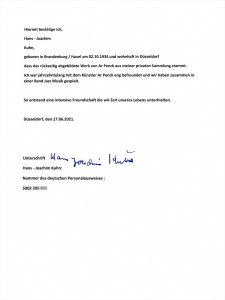
Hans-Joachim Kuhn confirms the provenance of an A. R. Penck artwork from his private collection in a signed statement dated June 17, 2021.
Central to this perspective is the impressive and extensive collection assembled by Hans-Joachim Kuhn, encompassing works from Penck’s most significant creative period.
Kuhn, Penck’s Jewish friend from his Leipzig years, remained a close companion of the artist for decades. The two also shared a passion for music, playing jazz together.
Ernst Raphael Jockels, in turn, maintained a close relationship with Kuhn until the latter’s death. Kuhn was also a close friend of the Jockels family and confirmed the authenticity of certain Penck works.
Here, personal recollection, provenance, and the knowledge of a longstanding friend of the artist come together.
A declaration dated June 17, 2021, confirms that the work reproduced in the article originated from Kuhn’s private collection. In the document, Kuhn also describes his decades-long friendship with Penck and their shared musical activities.
Documents of this kind give provenance both a name and a history. They lead back to the people whose everyday lives included these works of art.
For Jockels, his connection with Kuhn therefore also provides access to memories that the paintings alone cannot reveal: conversations, personal interests, and the significance of particular experiences in Penck’s life.
Expertise Has More Than One Source
Anyone collecting or assessing works by Penck will inevitably encounter the name Michael Werner. The long exhibition history of Galerie Michael Werner demonstrates its extensive engagement with the artist.
Yet this does not establish an exclusive claim to expertise. An artist’s life leaves traces in many places: galleries, museums, private collections, and among friends.
Jockels challenges what he sees as a recurring tendency to devalue Penck works that fall outside the holdings and transactions associated with Galerie Michael Werner.
“I consider it presumptuous to claim exclusive expertise and to dismiss works from other collections out of hand. Such an approach strikes me as being driven by market interests. The authenticity of a painting must be determined by concrete evidence, documentation, and verifiable arguments — not by which dealer handled its sale,” Jockels explains.
His connection with Kuhn, the conversations passed down over the years, and the thematic depth of his collection make Ernst Raphael Jockels an independent voice in the study and appreciation of Penck’s work.
He emerges as a second-generation collector and art dealer who brings paintings together, knows their provenance, and takes their historical questions seriously.
Above Tel Aviv, the two eyes remain open. They gaze upon a world that Penck sought to capture through symbols.
Anyone wishing to understand these paintings must also listen to those who witnessed their history.